Näytetään tekstit, joissa on tunniste matkakertomus englanniksi. Näytä kaikki tekstit

perjantai 8. toukokuuta 2026

Juomarahojen välttämättömyys 1910-luvun Helsingissä

Turun Sanomat
31.7.1913
Yhdysvaltain juomarahakäytäntö on usein kummastelun kohteena ja sitä verrataan Eurooppaan, jossa asiat ovat paremmin. Tavat eivät kuitenkaan olleet ikuisia siellä tai täällä. Yhdysvaltalainen Helen Gray teki tutkimusmatkan Suomeen kesällä 1913 ja harmitteli kirjassaan Finland, a little land that is true to itself; a study of Finland under Russia in comparison with the South of the United States (1914) Helsingin Fennia-hotellin juomarahavaateita. Ne perustuivat tarkoituksellisen alhaiseen palkkaan, aivan kuten Yhdysvalloissa nyt. 

Among the first things you notice after you have landed in Finland is the number of Russian uniforms, and you will observe, too, that the streets have Finnish, Swedish, and Russian names. To one who cannot afford to ride in carriages in her own land the Finnish drosky is an ever delight; often for twenty cents, and sometimes for ten, you may be transported to your destination. There was no room at the Societetshuset Hotel-Society House being a designation frequently used for hotel in Finland,-so I engaged quarters at the Fennia Hotel, across a wide space from the railway station. My single room cost me sixty cents a day, -cheap enough,-but feeing is a nuisance that you cannot escape, in these northern countries in particular, for the "portiers" often pay, instead of receive pay, for their posts and the maids and other attendants are paid very little, and expect you to remember them. At the Fennia Hotel one is served faithfully, and I can recommend it, for the "portier" speaks English and the attendants are obliging.

perjantai 26. syyskuuta 2025

Etelä-Suomesta on vähän sanottavaa (2/2)

Leidi New Yorkista ei ollut erityisen ihastunut matkustamiseen suurella rantatiellä Turun ja Pietarin välissä syyskuussa 1838.

It was well for us that we had made a good provision of table necessaries before leaving Stockholm, for very little was to be obtained, either from the Polish Jew innkeepers, or the worst supplied markets of Finish towns.

An unpleasant ride of seventy miles the first day brought us to a gray wooden town, called Bjersby. In the course of the day we crossed several navigable rivers coming from the north, and wound our tedious way round the head of several deep inlets of the sea. The peasantry were then, on the 21st day of September, busy in their grain harvest.

Björsby Pohjan länsipuolella 1935 kartassa.
Vanhatkartat.fi

The second day, after another uninteresting ride, without seeing either town or village, we arrived at Helsingfors, the Gibraltar of the Baltic. On an island near the coast is an immense fortification, perfectly impregnable; and when the Russians conquered Finland from the Swedes, it was betrayed into their hands by the treacherus commandant. In the roads, we saw riding at anchor four fine Russian frigates. With the exception of a large College, the place is entirely military.

I will not trouble you with the whole detail of our six tedious and fatiguing days' ride through rough and rocky Finland. Had not the roads been some of the best in the world, (owing to their being strewed with the fine abrasions from the granite rocks under the action of intense frosts,) it would have been too intolerable to endure. Besides, as another relief, the horses were excellent, and the people kind and obliging.

Rahvas muistutti intiaaneja. 

We saw numerous little bands of Finlapper from the interior "come down to salt," and revelling by the sea side, like a tribe of our Indians, on the luscious productions of the briny waters. They were all of extremely small stature, and thick set, with exceedingly dull and stolid countenances. They wore their great bushy hair down to their eyes, and over their shoulders, like the tags of a mop, and cut as square off at the ends.

Myös jäkälä ja Pyterlahden kaivos kiinnostivat.  

The ground and rocks in the forest were entirely covered with a singular species of tall white moss of a heautiful texture, the same, no doubt, as that on which the reindeer subsist in winter a little further north. I gathered some pretty specimens, which I shall send home. We saw where the Russian Government were quarrving cut some immense granite columns for the new Cathedral, now being erected in St. Petersburg.

(Pyterlahden kaivoksesta on samalta ajalta kuvia: tässä)

torstai 25. syyskuuta 2025

Etelä-Suomesta on vähän sanottavaa (1/2)

FamilySearchin uudehko sanahakumahdollisuus osui yllätyksekseni 1700- ja 1800-luvun sanomalehtiin. Jälkimmäisistä löysin pitkästä aikaa "uuden" ulkomaisen varhaisen matkakertomuksen Suomesta. Otsikolla Letters from Europe. By a lady of New York. From the New York American sanomalehdessä Daily National Intelligencer ilmestynyt matkakertomus kulki Keski-Euroopasta Norjan, Ruotsin ja Suomen kautta Venäjälle ja syksyllä 1839 kirjoittaja oli Konstantinopolissa ja Egyptissä.(*) 

Wikipedia kertoo, että Sarah Rogers Haight (1808-1881) matkusti Euroopassa 1835-39 aviomiehensä kanssa ja kaksi pientä lasta oli jätetty Pariisiin. Matkakirjeitään Lähi-idästä julkaistiin tuoreeltaan kirjoina Letters from the old world by A Lady of New-York ja sanomalehtikirjeet on koottu myöhemmin kirjaksi, jota ei Finnan perusteella ole Suomen kirjastoissa. Eikä siihen ole syytäkään, sillä tekstiä Suomesta on vähän, kuten monissa muissakin kertomuksissa, joissa matkalaiset ensisijaisesti siirtyvät Tukholman ja Pietarin välillä.

Pariskunnalle Haight ei ollut Tukholmassa tarjolla höyrylaivayhteyttä, joten matkanteko oli tuulen armolla.

The small amount of travel heretofore across the Gulf of Bothnia has not yet warranted the expense of a steam communication between the possessions of the King of Sweden and the newly acquired territories of the Czar. We were therefore subjected to the inconvenience of taking passage in one of the small fifty ton sailing pickets which ply regularly between Stockholm and Abo. It required one day to run down among the thousand islands which lie along the eastern coast of Sweden. We anchored at nightfall under the lee of one of the outer range of islands. In the morning, heavy weather prevented our venturing abroad upon the deep in our tiny craft. At noon, the wind shifting from north to west, with flowing sheet, we flew across the channel in about three hours, when we came among a range of islands which protect the western coast of Finland, similar to those on the opposite side of the gulf.

Maihinnoususta Ahvenanmaalla ei ole puhetta, mutta matkakirjeessä selitetään Bomarsundin linnoitussuunnitelmaa ja visioidaan Venäjän levittäytymistä. Tämän jälkeen jatkettiin matkaa.

At sunset of the second day, we were again obliged to anchor, not daring to venture further by star-light into this rocky labyrinth. The afternoon of the third day found us entering the harbor of Abo. The first objeets which greeted us were two beautiful ships, which, from their bright waists, we mistock for Americans. On a nearer approach we perceived by their names that they were natives of Finland, and as beautiful as the sea-nymphs who first kiss the wave in the waters of the Hudson.

Abo has much the appearance of a small American seaport, with wooden houses, painted in gay colors, streets wide and at right angles. It contains about 13,000 inhabitants.

Ei mainintaa Turun tuomiokirkosta tai kaupungin palamisesta vuosikymmen aiemmin.

(*) Päiväys Amsterdam. Daily National Intelligencer 28.8.1838Päiväys Dresden. Daily National Intelligencer 11.9.1838Päiväys Berlin. Daily National Intelligencer 4.10.1838Päiväys Christiania, (Norway). Daily National Intelligencer 9.10.1838. Päiväys Stockholm. Daily National Intelligencer 12.10.1838. Päiväys Helsingfors, (Finland). Daily National Intelligencer 22.10.1838.Päiväys St. Petersburg. Daily National Intelligencer 26.10.1838. Päiväys Moscow. Daily National Intelligencer 28.11.1838. Päiväys Constantinople. Daily National Intelligencer 22.7.1839. Päiväys Alexandria (Egypt). Daily National Intelligencer 13.8.1839 Päiväys Thebes. Daily National Intelligencer 15.10.1839Päiväys Thebes. Daily National Intelligencer 21.10.1839. Päiväys Beyrout (Syria), Daily National Intelligencer 31.10.1839

maanantai 12. kesäkuuta 2023

Laiva Tallinnasta Helsinkiin 10.7.1837


Helsingfors Tidningar kertoi 12.7.1837, että puoli kahdeksan aikaan maanantai-iltana 10.7. oli höyrylaiva Storfursten tuonut Tallinnasta huvimatkalle noin 240 henkeä. Näiden joukossa oli iso joukko Viron aatelisia, jotka olivat olleet Tallinnan markkinoilla.

Laivalla oli myös Frank Hall Standish, joka kirjassaan Notices on the northern capitals of Europe kuvaa saapumista näin
half of the population flocked to the pier on our arrival, and the military band hailed us with airs from the operas of Rossini, Bellini, and other fashionable composers: whilst a very diminutive steamer, capable of holding perhaps twenty persons, and no larger than a wherry, coquetted round us with a band of vocal performers, in German and Swedish songs.
Sanomalehti vahvistaa kuvauksen omilla sanoillaan: Så väl vid ankomsten som ock vid affärden helsades de besökande ifrån stranden med harmoni-musik.

Risteilypakettiin kuului vastaanottomusiikin lisäksi seurahuoneella illanvietto, joka jatkui aamun tunneille. Jonkin mittaisen levon jälkeen vierailla oli mahdollisuus tutustua kaupunkiin. Varmaan joku muukin kuin Standish kävi yliopiston museossa.
The Museum contains a good botanical collection, two rooms filled with specimens of natural history, and another allotted for coins, in which is to be seen the silver-wrought saddle of the sister of Charles the Twelfth, which is not formed otherwise than for a male, so that her Highness must have sat astride; it is similar to the light Spanish saddles of the present day. [...] the portrait of Rotorius, the Chancellor of Catharine the Second, washed and repainted, adorns one of the lecture-rooms of the Museum.
Paluukuljetus lähti iltapäivällä kello 3. Standishin mukaan tulomatka oli kestänyt 6 tuntia, joten joukko pääsi illaksi Tallinnaan.

P. S. Aiempi teksti Tallinnasta tulleista: Helsinki salakuljettajien päiväristeilykohteena

Kuva kirjasta Vuer af Helsingfors år 1838

tiistai 29. maaliskuuta 2022

Taiteilija vai käsityöläinen?

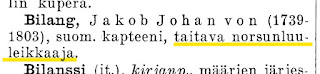
Muistinvaraisesti sanoisin, että Jacob Johan von Bilangia ei (ainakaan usein) mainita Suomen varhaisten taiteilijoiden joukossa. Kuten kuvasta näkyy, esimerkiksi 1920-luvun Pienessä tietosakirjassa hän on "taitava norsunluuleikkaaja".

Kansallisbiografiassa nimeään seuraa määrite "norsuunluunleikkaaja", mutta Pentti Virrankosken artikkelitekstissä norsunluunleikkausta kutsutaan taiteenalaksi. Bilang oli oppinnut sen ilmeisesti Ranskassa, jossa hän erosi sikäläisesti armeijasta 1762, mutta palasi Ruotsiin vasta vuonna 1765. Bilang sai 1766 ulkomaanmatkaan valtion apurahan ja Virrankoski epäilee tarkoituksena olleen taideopinnot. Paljon ei siis ole varmaa eikä Bilangin alkuperäisiä töitä tunneta säilyneinä, ainoastaan niistä tehtyä kaksi kuparipiirroskuvaa. 

Tai tämä oli Virrankosken tieto parikymmentä vuotta sitten. Nyt haku Nationalmuseumin kokoelmatietokannassa tuo esiin Bilangille attribuoidun sormuksen.

Bodil Beckman / Nationalmuseum CC BY-SA

Tai tarkemmin sanottuna kuvailutietojen mukaan sormus on signeerattu ja vuodelta 1762 eli tehty jo ennen arveltuja opintoja. (Ja ostettu 2016, mikä selittää aikaisemman tiedottomuuden.)

Saksalaisella Carl Gottlob Küttnerillä oli 1790-luvun lopussa mahdollisuus Karlskronassa tavata Bilang ja nähdä töitään. Englanniksi käännetyssä matkakertomuksessaan Travels through Denmark, Sweden, Austria and Part of Italy in 1798 & 1799. (1805) Küttner kirjoittaa
... Captain Bilang, of the navy. The latter is a native of Finland, and one of the best artificers in ivory that I am acquainted with. He executes landscapes, figures, ships, in a word, everything in ivory. Every part is well designed, and completely finished; but, upon the whole, his performances want taste. Many are of the diminutive and laborious workmanship of the sixteenth century, and remind me of a thousand things contained in the cabinets of artificial curiosities, which I can never see without lamenting the loss of time, and the waste of talent. M. Bilang's works will bear viewing with a microscope; but for what purpose does an artist produce performances which are too fine to be discerned by the naked eye? This man executes whole pictures, and landscapes with buildings, water, ships, men, and animals. (s. 107)

Siis enemmän taitoa kuin taidetta. 

Jacob Johan Bilang vietti suurimman osan elämästään Suomen ulkopuolella, mutta hän oli syntynyt Haapavedellä ja kuoli Helsingissä, joten suomalaisuus kestää peruskriittisen tarkastelun. Sen sijaan ensimmäinen vaimonsa Catharina Emerentia Scheding oli syntyjään Norrköpingistä ja avioliitossa vuonna 1777 syntynyt tytär Johanna todennäköisesti ei asunut koskaan Suomessa. Mikä on sääli, sillä hän oli Ihan Oikea Miniatyyritaiteilija.

Suomalaisissa kokoelmissa on piirroksista tehtyjä painokuvia ja niitä on myös Nationalmuseumin kokoelmissa. Jälkimmäisellä on Virrankosken mainitsema, norsunluukaiverrukseen perustuva Les Quatre Saisons, et La Promenade au Bord d'une Belle Vue.

perjantai 25. maaliskuuta 2022

Miten silta rakennettiin 1780-luvulla?

Sillan vaihtoehtoja
Eilisessä tekstissä pohjoisessa Suomessa matkannut jäi miettimään siltojen mahdollisuutta. Jos sellainen olisi päätetty tehdä, tekniikka ja lopputulos olisi voinut muistuttaa Matthew Consettin kuvausta Ruotsista:

I must not, however, omit observing their method of building bridges over their broadest and deepest rivers, several of which we passed in our Excursion to the northern parts of this kingdom. They are undoubtedly tremendous to the stranger, who might imagine with some kind of dread that instead of measuring the breadth of the waters he is about to cross, he would first be obliged to fathom the depth. 

They have no quay or wall on either side of the river on which to form a basis for such a building, it is therefore curiously and well constructed in this manner. The thickest end of a thick piece of timber, the length and shape of the mast of a large ship, is fastened to the rock or mountain, the other end extended on the water; a second timber of the same length is placed upon it, extending a fathom beyond it, and so a third, and fourth, to the middle of the stream, where it meets with another series of timber-masts from the opposite side, and this without any cement, but merely resting upon each other; so that in passing this, as it were, floating bridge, the elasticity is sometimes so great that about the middle it appears to swing and the weight of either horse or carriage dips it under the surface of the water; a circustance so tremendous and apparently dangerous  that a person unaccustomed to such bridges may well imagine that it will rise no more. 

I have frequently seen travellers stop and water their horses on the middle of the bridge when they already touch the water from the subsiding of the platform. When freed from the weight of the carriage or passenger it immediately rises to its proper height.

(A Tour through Sweden, Swedish-Lapland, Finland and Denmark. In a series of letters, illustrated with engravings. 1789, 122)

Kuva: Jacob Leupold. "Theatrum pontificiale" (1774) 

perjantai 7. tammikuuta 2022

Kolme näkymää Torniosta ja Tornionjoelta

Ottaen huomioon eilisen Uppsala-kuvan erot todellisuuteen, saman kirjan (Pierre Marie Louis de Boisgelin de Kerdu. Travels through Denmark and Sweden. Vol II. 1810) kuvien 

  1. part of the Town of Torneo
  2. near Upper Torneo
  3. on the River Torneo
dokumenttiarvo on kyseenalaistettavissa, mutta koska varhaiset kuvat Suomesta ovat kortilla, niin epäluotettavuudesta ja heikkolaatuisesta digitoinnista huolimatta.
Osa Tornion kaupunkia

Lähellä Yli-Torniota (?)

Tornionjoella

Kyseinen kirja oli itselleni "uusi" Suomen vierailu. Ranskalaismiehet eivät tekstin perusteella käy lähelläkään Torniota, mutta he tekevät klassisen Kuninkaantien läpikulun. Viaporista oli sivukaupalla tekstiä, mutta Helsingistä vain kuittaus: "We may venture to affirm, that we saw as many cows as people in passing through the streets"

torstai 6. tammikuuta 2022

Käynti Uppsalassa 1770-luvulla

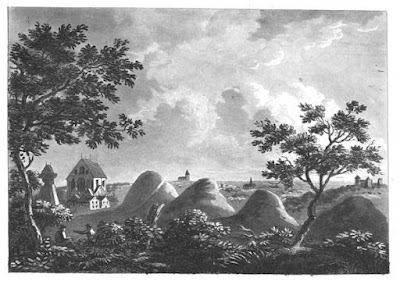
Hyvällä tahdolla yllä olevaa voi pitää kuvana Uppsalan kuningaskummuista, mutta vain siinä tapauksessa, ettei piirtäjä ole käynyt lähimaillakaan. Kuva on Pierre Marie Louis de Boisgelin de Kerdun kirjasta Travels through Denmark and Sweden. Vol II. 1810, jossa monen muun matkakertomuksen tapaan poiketaan Uppsalassa. Kuningaskummut eivät ole kenellekään pääkohde, mikä ei varsinaisesti yllättänyt.

Mutta Nathaniel Wraxallin kokemus vuonna 1774 yllätti. 
... we proceeded to Upsal, and arrived there early in the evening. I intended to devote the following day to the survey of the colleges, public buildings, curiosities, paintings, and all those exhibitions of art and learning usually found in seminaries of knowledge and study. The Swedes had inspired me with such exalted ideas of this university, that I was only fearful left a single day might be far inadequate to such an undertaking, and wishen to have spent a longer time in so agreeable an occupation. 
 
I am, however, at present most compleatly undeceived, and can assure you that Upsal has hardly one inducement to draw a man of taste to visit it, unless from being the residence of a Linnaeus. This Lycaeum of the north has not one piece of painting within it's walls, and only two of sculpture, which are busts of Gustavus Adolphus and Charles the XIth. 
 
A gentleman who resides here, and who is son of the late archbishop of Upsal, did us the honor to be our Ciceroni, and to conduct us over the place. I enquired of him how many colleges there were, and which was the most celebrated. "Sir," said he, "we have three; but I cannot say that any one of them deserves your notice. The principal objects of attention are the library, the cathedral, and the botanical garden. I know not of any thing else." 
 
The first of these is a neat good building, and there is a cabinet in it, at which for want of a better employment I spent an hour or two, while the librarian shewed me a number of little trinkets, rather than rarities, which are preserved with great care. Among these is the identical bag which Judas kept, one of the thirty pieces of silver money which he received for his perdify in delivering up his master, and a pair of red slippers in which the Virgin Mary paid a visit to her cousin Elizabeth. I must do the man the justice to say, that he blushed as he shewed them to me (Cursory Remarks Made on a Tour through Some of the Northern Parts of Europe, Particularly Copenhagen, Stockholm, and Petersburgh. 1775, s. 167-169)

keskiviikko 5. tammikuuta 2022

Rikollisuutta Ruotsissa vuonna 1799

Eilen mainittu naisten uskottomuuden yleisyys ei ollut ainoa yllätys loordi Broughamin muistelmissa. Yleisesti (Suomen tapaan) rehelliseksi kehutussa Ruotsissa hän joutui kestikievarissa lokakuussa 1799 varkaan uhriksi:

Oct. 9. Our journey had been through forests, only interrupted here and there by pieces of cultivated plain, and occasionally great masses of rock, the inns being generally bad. At one of them we had our pistols broken, and one of them stolen. The excuse was that they had been left out, and that there were many passengers beside ourselves. 

But as our writing-desks and the rest of our luggage had been in our bedrooms, and we never absent except for half an hour while our supper was getting ready, and while we were in the kitchen to hurry them with it, we therefore never thought of examining desks or luggage, and only found next day (October 10), on our arrival at Jönköping (a singular-looking town half fortified on the Wettern Sea), that our desks had been opened and the greater part of the money taken. 

October 10 was spent in going to the judge to have a proclamation published, offering a reward through all the churches, and in our writing to Copenhagen to have the bills which had been taken stopped ; so we did not leave Jönköping till eleven at night, Our carriage having now got a canvas covering on it, we resolved to travel all night as soon as a driver could be found ; and in the state of our broken arms, we were comforted by being told that a Jew had been robbed and murdered not far from the town. (The Life and Times of Henry, Lord Brougham. Vol 1. 1871, s. 141-142)

Varkaiden uhrit siis peruttivat setelinsä (kuten minun nuoruudessani matkashekit), kuuluttivat varkaan perään kirkoissa ja saivat lohdutuksekseen kuulla, että huono-onnisempi yksilö oli sekä ryöstetty että murhattu.

Tukholmaan päästyä Ruotsin rikollisuus saa lisäväriä:

While we were at Stockholm several instances happened: a man killed his wife because she would not assist him in corrupting his own daughter. Three men were hanged for forgery (one of them a nobleman). They continued forging notes even whilst in prison. A gang of thieves robbed a noble's house with the assistance of his servants. Another gang formed a plan to rob and murder indiscriminately, throwing the bodies into the sea; and this they actually perpetrated on several. (s. 165-166)

tiistai 4. tammikuuta 2022

Ruotsin 1700-luvun uskottomat naiset

Opus The present state of all nations (1768) tarjosi hitusen yllättävän tai epätavallisen näkökulman Ruotsin naisiin
The women are generally fair, and wellshaped, reputed more eminent for chastity before, than for fidelity after wedlock. They are very fruitful, and, from the highest to the lowest, kept by their husbands under such authority, as would be deemed oppression in France or England. (s. 246)

En oikein ymmärrä miten miesten armottomaan auktoriteettiin voidaan yhdistää vaimojen uskottomuus.

Joko uskottomuudesta oli yleisesti liikkeellä käsitys tai loordi Brougham oli tavannut Smolletin tekstiä ennen lähtöään Ruotsiin. Muistelmissaan hän kertoi Tukholman naisväestä 1799 näin

The manners of the people in this capital are extremely dissolute, particularly of the people of fashion. The instances of profligacy about Court almost exceed belief in so northerly a situation. The women of fashion carry on their amours in the most scandalous and public manner. Madame de L- , whose husband is minister at the Hague, lives openly with Baron d'E-. Her sons, two of the most fashionable young men in Stockholm, are very intimate with the baron, and with the minister too. 

She is daughter of the late Count J- . On her husband complaining to him soon after his marriage, he asked him, "Have you any paper, any writing, any title-deed, by which to plead exemption from the common lot of husbands"? This kind of instance might be multiplied to an endless extent. This profligacy seems to descend to the lower orders. Their manners are growing corrupted too. (Henry Peter Brougham: The Life and Times of Henry, Lord Brougham. Vol 1. 1871, s. 165)

Eksoottiselta kuullostavan tarinan verifioinnin suhteen olin täysin kädetön, mutta onneksi on diplomaatteja ja Alankomaita tutkiva kaveri, joka neuvoi verkkojulkaisun Repertoria vertegenwoordigers in Nederland en in het buitenland 1584-1810, joka hänen taidoillaan paljasi Ruotsin Haagin lähettilään vuonna 1799: Fredrik Adolf von Löwenhjelm. Lupaavasti alkukirjain stemmaa ja Adelsvapen kertoo, että vaimonsa oli kreivin tytär. Mutta kreivillinen suku on von Fersen, joka ei ala J:llä. Eikä parilla ollut kahta poikaa. Kylläkin yksi, joka oli nuoren miehen iässä 1799. 

Christina Augusta Löwenhielm yhdistetään (Wikipediaan tukeutuen) useisiin suhteisiin, joista yksi oli paroni von Essen eli tarinassa on jonkinlainen tosipohja. 

maanantai 3. tammikuuta 2022

Kaarle XII:n kuolinvaatteet ja muuta kiinnostavaa

Yksi Tukholman päänähtävyyksiä ulkomaisten matkailijoiden kertomusten perusteella oli "arsenaali", jossa oli jonkinlainen Livrustkammaren ja armeijamuseon alkio. William Coxe kuvasi vierailuaan vuonna 1779 näin:

THE arsenal of Stockholm contains an immense number of standards and trophies, taken chiefly from the Imperialists, Poles, Russians, and Danes. Many of these standards were supplied by Gustavus Adolphus, Baner, Torstenson and Wrangel, by Charles Gustavus, but principally by Charles XII. whose military atchievements proved the ruin of his country: nor could I avoid remarking, that while this collection proudly displayed the trophies of Narva, the Russians possess Narva itself, with all Livonia and other provinces dismembered from Sweden.

Among other curiosities, I observed the skin of the horse stuffed, which carried Gustavus Adolphus at the battle of Lutzen, where he received his death; a boat made by Peter the Great at Sardam in Holland, and taken by a Swedish vessel as it was conveying by sea to Petersburgh; and, what particularly attracted my notice, the clothes and hat worn by Charles XII. when he was shot in the trenches before Frederickshall. As many various reports have been spread relative to the death of that monarch, and as proofs that he was assassinated have been attempted to be drawn from the state of those clothes, and particularly of his hat, I examined them with peculiar attention. (Travels into Poland, Russia, Sweden and Denmark. 1792, s. 78)

Tätä ennen paikalla käynyt Nathaniel Wraxall (Cursory Remarks Made on a Tour through Some of the Northern Parts of Europe, Particularly Copenhagen, Stockholm, and Petersburgh. 1775) tutki Kaarle XII:n kuolinvaatteet myös hyvin tarkasti, mutta ei mainitse mitään muuta esineistöä.

Matthew Consett seurasi edeltäjiensä mallia 1784 keskittyen kuninkaan asuun:

On Saturday the 10th. we made a party to view the Citadel, an ancient building, where may be seen the royal armory, colours, and other trophies worthy of observation, taken by the military Heroes of the nation. The curiosities which we thought most remarkable were, Charles the XII's shirt, coat, boots and gloves which he wore at the time when he was killed at the siege of Fredrickshall. (A Tour through Sweden, Swedish-Lapland, Finland and Denmark. In a series of letters, illustrated with engravings. 1789, s. 20)

Kuinka tarkasti sinä katsoisit 60 tai 70 vuotta sitten väkivaltaisesti kuolleen kuninkaan vaatteita?

Mutta mistä arsenaalista tai linnoitteesta miehet puhuvat? Livrustkammaren verkkosivujen historiakatsaus ei auta ruotsiksi eikä englanniksi, mutta onneksi on Projekt Runeberg. T. J. Petrelli selostaa asiaa vakuuttavasti artikkelissa Några ord om livrustkammarens och statens trofésamlings inbördes förhållande (Svensk Tidskrift 12. 1922). Onnekkaasti kokoelmat oli siirretty vanhasta linnasta vuonna 1691 eli ennen tulipaloa. Sijoituspaikka oli De la Gardie suvun palatsi, joka nimellä Makalös tunnetaan. Paitsi, että sitä alettiin kutsua Arsenaaliksi kokoelmien siirron jälkeen.

Makalös/Arsenaali oikealla Norrmalmin puolella
Elias Martinin maalaus, Wikimedia

Aika jännää, että kukaan miehistä ei kirjoita rakennuksesta mitään. Se tuhoutui tulipalossa 1820-luvulla ja on saanut komeudestaan nykyiseen Tukholman kaupunginmuseon perusnäyttelyyn pienoismallin. Jonka yhteydessä en muista olleen mainintaa lähes sadan vuoden museokäytöstä.

Melko pian Consettin käynnin jälkeen kokoelmat siirrettiin Fredrikshovin linnaan Östermalmilla. Täytyy tunnustaa, että vaikka olen Östermalmia suurella hartaudella pitkin ja poikin kulkenut, niin tällaisesta rakennuksesta en mitään ole tiennyt. Olisi yhteys Suomeenkin, sillä Wikipedian mukaan "Fredrikshovissa pidettiin vankeina pidätettyjä Anjalan liiton jäseniä."

sunnuntai 2. tammikuuta 2022

Ruotsin terveyslähteillä 1700-luvun lopulla

Paikka Ruotsissa, jonne Suomestakin jossain määrin matkustettiin oli Medevin terveyslähde. Siellä vuonna 1784 käynyt William Coxe kuvaa kohdetta näin

At Motala, we crossed the river of the same name, which issues from the Wetter, and is not navigable for the smallest vessels, and soon arrived at Medwi, the Swedish spa.

Medwi is pleasantly situated in a gently waving and richly wooded country. The lodgeing-houses form one street of uniform wooden buildings painted red. The walks and rides are delightful, particularly to the banks of the Wetter. The waters of the Spa are vitriolic and sulphureous.

The regulations of this place seem more calculated for the accommodations of the sick who came to drink the waters, than for the company who assemble for pleasure. Between five and six in the morning the company are awakened by the ringing of a large bell, when they usually rise, drink the waters, breakfast, ride out, or walk. Precisely at twelve dinner is served in a large hall, to which all the company repair. After dinner they play at cards till five, when they take their afternoon's airing. At seven supper is served in the same hall; at nine the bell rings, the gates are shut, no carriages are admitted, and the company mostly retire to bed.

We had purposed passing a week at Medwi, but the season being past, and the company gone, excepting a few invalids, we continued our journey to Stockholm, through Linkioping and Nordkioping. (Travels into Poland, Russia, Sweden and Denmark. s. 376-377)

Elias Martinin piirros, Nationalmuseum

Käyttökauden ulkopuolella terveyslähde on siis ankea paikka. Saksalainen Carl Gottlob Küttner puolestaan poikkesi yllä näkyvässä Ramlösassa parikymmentä vuotta myöhemmin.

We went this afternoon to Ramlösa; a place about three miles from Helsingburg, celebrated for its mineral waters, and much frequented by people of rank. The spot is highly romantic: but I saw no building; except a miserable house (or rather a hall) constructed of wood, where tea, coffee, and lemonade, are served. Upon paying twelve schillings we are admitted, and obtain a right to refreshments. 

The number of persons of all classes which I saw there, was very great. The common people thronged round the house, or climbed up on the rails by which it is surrounded, to see the fine folks in and before the place. 

For my part, I cannot conceive whence all the genteel company can come, who drive to this place in splendid equipages, with two, four, and six horses. Our host informed us that they were partly from the neighbouring gentlemen's seats, and also many strangers from different parts of the kingdom, particularly Stockholm: but he could not tell where they all fine lodgings, for very few reside at Helsinburg; and as to the gentlemen's seats, I could scarcely discover from the eminences near the town, which command a tolerably extensive view, a single creditable house in all the adjacent country as far as my eye could reach. (Travels through Denmark, Sweden, Austria and Part of Italy in 1798 & 1799. 1805, s. 43)

Terveyslähteistä Suomessa voi lukea digitoituna(kin) Antero Heikkisen kirjasta Terveyden ja ilon tähden : herrasväki liikkeellä Suomessa 1700- ja 1800-luvuilla.

perjantai 26. marraskuuta 2021

Matkalainen Torniossa 1851

Preussilainen Harris Newmark oli 17-vuotiaana aloittelevana mustetta myyvänä liikemiehenä Haaparannassa kesällä 1851. Paljon myöhemmin hän muisteli kirjassaan Sixty Years in Southern California 1853-1913 Haaparannasta Tornioon tekemäänsä hyvin lyhyttä vierailua.
...while at Haparanda, I was seized with a desire to visit Torneå, in Finland. 
I was well aware that if I attempted to do so by the regular routes on land, it would be necessary to pass the Russian customhouse, where officers would be sure to examine my passport; and knowing, as the whole liberal world now more than ever knows, that a person of Jewish faith finds the merest sally beyond the Russian border beset with unreasonable obstacles, I decided to walk across the wide marsh in the northern part of the Gulf, and thus circumvent these exponents of intolerance. Besides, I was curious to learn whether, in such a benighted country, blacking and ink were used at all. 
I set out, therefore, through the great moist waste, making my way without much difficulty, and in due time arrived at Torneå, when I proceeded immediately to the first store in the neighborhood; but there I was destined to experience a rude, unexpected setback. An old man, evidently the proprietor, met me and straightway asked, "Are you a Jew?" and seeing, or imagining that I saw, a delay (perhaps not altogether temporary!) in a Russian jail, I withdrew from the store without ceremony, and returned to the place whence I had come. 

tiistai 11. toukokuuta 2021

Puolalaistyttö Imatran koskella

Vielä löytyy lehdissä ihmeteltävää. Vuosien varrella teksti- ja kuvahakuni ovat toisinaan osuneet lastenlehteen St. Nicholas, mutta en ole koskaan julkaisuun perehtynyt. Ajatellut vaan englantilaiseksi tai amerikkalaiseksi lastenlehdeksi. Mutta ei ollutkaan niin yksinkertaista, mikä selvisi kun hakusanani oli lukijakirjeiden lomassa. 

Näissä tyttö Australiasta oli pyytänyt paperinukkeja ja kiitti nyt lähetyksistä, joita oli saanut paikoista "Switzerland, Austria-Hungary, Egypt, Jamaica, England, Scotland, Mexico, all parts of Canada, the United States, and South America". Saman numeron palstalla kirjoittajat esittelivät itsensä sanoin "I am a little girl who lives on a Hudson's Bay post on the Labrador coast", "I live in Brooklyn", "I am a little Greek girl living in Geneva". Kansainvälistä lastenkulttuuria maaliskuussa 1896

Pietarissa painettu kuva Imatran koskelta. Gallica

Kahden ja puolen sivun osaston yksi kirje oli Pietarissa asuvalta puolalaistytöltä, joka teki vanhempiensa kanssa huviretken Imatran koskille. Mennessä junalla ja palaten osittain Saimaan kanavaa, Juustilan kautta. Lisäsin alkuperäiseen kappaleenvaihtoja selvyyden vuoksi.

St. Petersburg, Russia. 

Dear St. Nicholas : Perhaps you would like to hear from a little Polish girl who lives in St. Petersburg. We have been taking you for two years, and we like you very much and always look forward to your arrival. 

I thought some of your readers would like to hear of a trip we made to the greatest waterfall in Europe, called "Imatra," in Finland, near Lake Saima. We left St. Petersburg at five o'clock in the afternoon. The train for Finland was so crowded that we could not get places for all our party until we came to Terioky, where some people left the train. We had to change at Viborg, where we had just ten minutes to take our tea, which was very hard to get. There were so many people hurrying and scurrying on all sides, and then so many false alarms, that we thought we should be left behind. However, at last we were comfortably seated and could enjoy the lovely views as we were carried rapidly along. 

At eleven o'clock we arrived at Imatra and took the diligence and were soon within hearing of the great rushing water of the falls. Oh, how beautiful it was in the moonlight! The hotel was very full, and as we had secured our rooms beforehand by telegram, and were very tired, we went to bed and slept very soundly notwithstanding the noise of the water in its mad rush from rock to rock. In the morning we were soon ready to explore. When we came quite near to the fall, after descending many steps, the water was quite white, and it seemed as if it were boiling with the force and rush of the great volume. 

We could not stay very long, as we intended to make an excursion to Rauha. The diligence was ready when we went back to the hotel, and we started with three horses (which we call "troika") up hill and down hill, flying along the road singing and laughing all the way until we arrived in sight of the lake at Rauha. There is a hotel where we ordered luncheon, and while it was being prepared we took a boat and went for a row on the lake. In an hour we came back very hungry, had our lunch and returned to Imatra to rest before going to visit the little falls of Imatra. It seemed to me very strange that the waters were quite calm on both sides of the river, but the middle was one seething mass. We hired a man to throw in a barrel and a wooden buoy, to see the effect, and very rapidly they were carried along from wave to wave, dashing against the rocks, until they were carried into the smoother water, where a boy could go in a boat to fetch them. 

Next morning we took a diligence to Joös-Tilla, where we lunched, and then went in the steamer through Lake Saima. We had to pass through some canals, and it was very amusing to go lower and lower as we passed through the locks. We arrived at Viborg, where we dined, and afterwards took the last train to St. Petersburg, where we remained for the night, or rather for the next morning, for we did not arrive till 2 o'clock A. M., and at ten we were on our way home. My little brother and sisters were waiting to receive us. We were once seven children, but we lost our eldest brother; he was a lover of St. Nicholas.

J. B---.

P. S. Varastoinnissa rikkoutuneen Gallican linkin takia jouduin tekemään sielläkin tekstihaun ja osuin toiseen pikakäyntiin Imatralla Raoul Lajoyen kirjassa Mes vingt-huit jours en Russie (1892). 

lauantai 5. syyskuuta 2020

Enontekiöltä Tornioon syksyllä 1808

Gallica
Saksalainen geologi Leopold von Buch tutkimusmatkaili Norjassa ja Ruotsissa vuosina 1806-08 eli juuri ennen Suomen sotaa. Matkastaan kirjoittamansa kirja Reise durch Norwegen und Lappland painettiin Berlinissä 1810 ja käännös englanniksi Lontoossa 1813. Siinä kerrotun mukaan hän ei ollut kiinnostunut nykyisen Suomen Lapista, mutta tuli jokia alas Enontekiöstä Muonion kautta Tornioon syyskuussa 1808. En huomannut kuvauksen kohdalla mitään mainintaa jo käynnissä olleesta sodasta, jossa käytiin samaan aikaan taisteluita Pohjanmaalla

Muoniossa von Buch näki mielestään ison kylän, jossa hänet majatalossa ohjattiin lasi-ikkunoilla varustettuun huoneeseen, jossa sai syödä "maitonsa" hopealusikalla. Näin vaikka vilja ei tällä korkeudella juuri koskaan kypsynyt ja väestö eli perunan varassa.

Von Buch näki suomalaisten edistyksen pysähtyneen Muonioon siksi, että heidän liikaväestönsä oli muuttanut pohjoisemman Lapin sijaan Jäämeren rantaan Norjassa. Saamelaisten ja suomalaisten ero oli hänelle selvä, saamelaiset olivat lyhyitä ja suomalaiset pitkiä. (Nykytiedolla pituuskasvuun vaikuttaa genetiikan lisäksi nautitun ravinnon määrä ja laatu.)

Muonion kirkkoherra Matias Kolström totesi viljasadon epäonnistuvan lähes joka vuosi ja väen elävän pääosin perunoilla ja kalalla. Hänestä von Buch oli onnekas saadessaan matkaa jatkaessaan koskenlaskijakseen Kolarin Juhanin, joka oli kaikkein kokenein.
The two men in the fore-part of the boat have a most frightful appearance. Their fixed looks, their eyes, which seem to start from their sockets, endeavour to read every thought of the pilot, whether they ought to row in the fall more rapidly or more slowly. Their own preservation depends on their correct under standing of the thoughts of the pilot. Every muscle is stretched in the highest degree, and the arms only are in motion. 
Von Buch käyttää koskista kirjoitusasua Eianpaiku ja 30 vuotta myöhemmin paikalla käyneet ranskalaiset Eyanpaïka. Jälkimmäisiin, joiden muita kuvia esittelin sarjassa Matka 1839, kosket tekivät niin suuren vaikutuksen, että niistä on kirjassa Voyages de la Commission scientifique du Nord, en Scandinavie, en Laponie, au Spitzberg et aux Feröe kaksi näkymää.
Köngäksen ruukki samaisessa ranskalaisessa kirjassa
Ennen Torniota pysähdyttiin Köngäksen ruukilla, joka oli aivan muuta kuin ympäristönsä. Jossain sen eteläpuoleisessa kylässä (Tuttila? Pellon paikkeilla?) von Buch näki ensimmäiset kypsät herneet ja samassa paikassa kasvoi naurista ja piparjuurta.

Ylitorniosta matkaa jatkettiin tiellä hevoskyydillä.
I reached Korpikylä at mid-day : the horse and car were quickly changed, and trees, houses, and fields, flew rapidly by. The road was wholly covered with people: they came from the church ; youths and maidens hurrying gaily along, and the old people as venerable as Armenian priests, dressed in a long black talar, or overall, buttoned from the throat downwards, a sulphur-yellow Swedish scarf round the body, and a small black bonnet on the head. A singular dress for a peasant. We imagine we see so many ghosts. They are, however, clean-looking, rich, and prosperous people. About two o'clock I passed the beautiful church of Charles Gustavus, surrounded by large farm houses, and at Frankilä, a short distance from it, I again changed horse and car. They were not in readiness, and yet I no where waited a quarter of an hour, notwithstanding I was never fortunate enough to make myself understood to the people, who speak only Finnish, and not a single word of Swedish. 
Käännöksen alaviitteen mukaan ylitorniolaisten asuista on kuva S. G. Hermelinin kirjassa Special kartor och ritningar till beskrifning öfver Sverige. Jostain syystä siitä on verkkoon käytettävässä formaatissa päätynyt vain karttoja. Tornion kaupunki ei tehnyt saksalaiseen suurta vaikutusta. Kadut ovat päällystämättömiä, rakennukset enimmäkseen vaatimattomia ja kaupunki hiljainen.
There are a number of streets, it is true ; they are generally straight, and intersect one another at right angles. A plan of the town would exhibit it as large and regular. But these streets are not paved ; they have quite the look of so many fields or meadows, they are so grown over with grass. We see few traces of footsteps in them, and carriages only go through the lower principal street. The upper streets are actually barred. The inhabitants have the exclusive right of feeding their own cows on them, and perhaps also of making hay; [...] How-ever, the road from Stockholm to the Bothnian Gulph goes through the market place, and the streets which run from it towards the river-side. In this quarter, therefore, every thing looks better and more respectable. We see several houses two stories high, painted and ornamented; and at the river side the house of M. Carlenius, the merchant, has a most distinguished appearance. All the other houses are merely low huts, and they are situated at a distance from one another; for every hut has generally its little garden beside it, containing flowers, garden stuffs and herbs, and beautiful mountain-ash trees. The life and stir is confined to the landing-place on the banks of the river, and it is soon lost in the empty streets. 
[...] The people seem here, however, to enjoy life comfortably in their own way. They frequently meet together— in the morning at the apothecaries in the market place, at midday in the public-houses, in the afternoon again at the liquor flasks of the apothecary, and in the evening the punch flows in streams in the coffee-house. There is no want there of frequent sallies of joviality and animation. They are beings who are very faintly moved by the convulsions of the world. 

keskiviikko 27. toukokuuta 2020

Laatokan risteily englanniksi: Sortavala

Orjatsaari Laatokassa. Lappeenrannan museot,
CC BY-NC-ND 4.0
The Atlantic Monthlyssa toukokuussa 1864 julkaistun matkakertomuksen amerikkalaiset matkalaiset ohittivat Valamon nopeasti, aikoen palata sinne takaisin. Tämä jätti heille mahdollisuuden tutustua laivan päätesatamaan eli Sortavalaan. Kuvauksessa mainitut krinoliinit kaventavat matkan todennäköisen ajoituksen 1860-luvun alun kesiin.
After some fifteen or twenty miles from the island, we approached the rocky archipelago in which the lake terminates at its northern end,—a gradual transition from water to land. Masses of gray granite, wooded wherever the hardy Northern firs could strike root, rose on all sides, divided by deep and narrow channels. "This is the scheer," said our captain, using a word which recalled to my mind, at once, the Swedish skär, and the English skerry, used alike to denote a coast-group of rocky islets. The rock encroached more and more as we advanced; and finally, as if sure of its victory over the lake, gave place, here and there, to levels of turf, gardens, and cottages. Then followed a calm, land-locked basin, surrounded with harvest-fields, and the spire of Serdopol arose before us.
Of this town I may report that it is called, in Finnish, Sordovala, and was founded about the year 1640. Its history has no doubt been very important to its inhabitants, but I do not presume that it would be interesting to the world, and therefore spare myself a great deal of laborious research. Small as it is, and so secluded that Ladoga seems a world's highway in comparison with its quiet harbor, it nevertheless holds three races and three languages in its modest bounds. The government and its tongue are Russian; the people are mostly Finnish, with a very thin upper-crust of Swedish tradition, whence the latter language is cultivated as a sign of aristocracy.
We landed on a broad wooden pier, and entered the town through a crowd which was composed of all these elements. There was to be a fair on the morrow, and from the northern shore of the lake, as well as the wild inland region towards the Saïma, the people had collected for trade, gossip, and festivity. Children in ragged garments of hemp, bleached upon their bodies, impudently begged for pocket-money; women in scarlet kerchiefs curiously scrutinized us; peasants carried bundles of freshly mown grass to the horses which were exposed for sale; ladies with Hungarian hats crushed their crinolines into queer old cabriolets; gentlemen with business-faces and an aspect of wealth smoked paper cigars; and numbers of hucksters offered baskets of biscuit and cakes, of a disagreeable yellow color and great apparent toughness. It was a repetition, with slight variations, of a village-fair anywhere else, or an election-day in America.
Passing through the roughly paved and somewhat dirty streets, past shops full of primitive hardware, groceries which emitted powerful whiffs of salt fish or new leather, bakeries with crisp padlocks of bread in the windows, drinking-houses plentifully supplied with qvass and vodki, and, finally, the one watch-maker, and the vender of paper, pens, and Finnish almanacs, we reached a broad suburban street, whose substantial houses, with their courts and gardens, hinted at the aristocracy of Serdopol. The inn, with its Swedish sign, was large and comfortable, and a peep into the open windows disclosed as pleasant quarters as a traveller could wish. A little farther the town ceased, and we found ourselves upon a rough, sloping common, at the top of which stood the church with its neighboring belfry. It was unmistakably Lutheran in appearance,—very plain and massive and sober in color, with a steep roof for shedding snow. The only attempt at ornament was a fanciful shingle-mosaic, but in pattern only, not in color. Across the common ran a double row of small booths, which had just been erected for the coming fair; and sturdy young fellows from the country, with their rough carts and shaggy ponies, were gathering along the highway, to skirmish a little in advance of their bargains.
The road enticed us onward, into the country. On our left, a long slope descended to an upper arm of the harbor, the head of which we saw to be near at hand. The opposite shore was fairly laid out in grain-fields, through which cropped out, here and there, long walls of granite, rising higher and higher towards the west, until they culminated in the round, hard forehead of a lofty hill. There was no other point within easy reach which promised much of a view; so, rounding the head of the bay, we addressed ourselves to climbing the rocks, somewhat to the surprise of the herd-boys, as they drove their cows into the town to be milked.
Once off the cultivated land, we found the hill a very garden of wild blooms. Every step and shelf of the rocks was cushioned with tricolored violets, white anemones, and a succulent, moss-like plant with a golden flower. Higher up there were sheets of fire-red pinks, and on the summit an unbroken carpet of the dwarf whortleberry, with its waxen bells. Light exhalations seemed to rise from the damp hollows, and drift towards us; but they resolved themselves into swarms of mosquitoes, and would have made the hill-top untenable, had they not been dispersed by a sudden breeze. We sat down upon a rock and contemplated the widespread panorama. It was nine o'clock, and the sun, near his setting, cast long gleams of pale light through the clouds, softening the green of the fields and forests where they fell, and turning the moist evening haze into lustrous pearl. Inlets of the lake here and there crept in between the rocky hills; broad stretches of gently undulating grain-land were dotted with the houses, barns, and clustered stables of the Finnish farmers; in the distance arose the smokes of two villages; and beyond all, as we looked inland, ran the sombre ridges of the fir-clad hills. Below us, on the right, the yellow houses of the town shone in the subdued light,—the only bright spot in the landscape, which elsewhere seemed to be overlaid with a tint of dark, transparent gray. It was wonderfully silent. Not a bird twittered; no bleat of sheep or low of cattle was heard from the grassy fields; no shout of children, or evening hail from the returning boats of the fishers. Over all the land brooded an atmosphere of sleep, of serene, perpetual peace. To sit and look upon it was in itself a refreshment like that of healthy slumber. The restless devil which lurks in the human brain was quieted for the time, and we dreamed—knowing all the while the vanity of the dream—of a pastoral life in some such spot, among as ignorant and simple-hearted a people, ourselves as untroubled by the agitations of the world.
We had scarce inhaled—or, rather, insuded, to coin a paradoxical word for a sensation which seems to enter at every pore—the profound quiet and its suggestive fancies for the space of half an hour, when the wind fell at the going down of the sun, and the humming mist of mosquitoes arose again. Returning to the town, we halted at the top of the common to watch the farmers of the neighborhood at their horse-dealing. Very hard, keen, weather-browned faces had they, eyes tight-set for the main chance, mouths worn thin by biting farthings, and hands whose hard fingers crooked with holding fast what they had earned. Faces almost of the Yankee type, many of them, but relieved by the twinkling of a humorous faculty or the wild gleam of imagination. The shaggy little horses, of a dun or dull tan-color, seemed to understand that their best performance was required, and rushed up and down the road with an amazing exhibition of mettle. I could understand nothing of the Finnish tongue except its music; but it was easy to perceive that the remarks of the crowd were shrewd, intelligent, and racy. One young fellow, less observant, accosted us in the hope that we might be purchasers. The boys, suspecting that we were as green as we were evidently foreign, held out their hands for alms, with a very unsuccessful air of distress, but readily succumbed to the Russian interjection "proch" (be off!) the repetition of which, they understood, was a reproach.
That night we slept on the velvet couches of the cabin, having the spacious apartment to ourselves. The bright young officer had left for the copper mines, the pilgrims were at Valaam, and our stout, benignant captain looked upon us as his only faithful passengers. The stewards, indeed, carried their kindness beyond reasonable anticipations. They brought us real pillows and other conveniences, bolted the doors against nightly intruders, and in the morning conducted us into the pantry, to wash our faces in the basin sacred to dishes. After I had completed my ablutions, I turned dumbly, with dripping face and extended hands, for a towel. My steward understood the silent appeal, and, taking a napkin from a plate of bread, presented it with alacrity. I made use of it, I confess, but hastened out of the pantry, lest I should happen to see it restored to its former place. How not to observe is a faculty as necessary to the traveller as its reverse. I was reminded of this truth at dinner, when I saw the same steward take a napkin (probably my towel!) from under his arm, to wipe both his face and a plate which he carried. To speak mildly, these people on Lake Ladoga are not sensitive in regard to the contact of individualities. But the main point is to avoid seeing what you don't like.

tiistai 26. toukokuuta 2020

Laatokan risteily englanniksi: Pikakäynti Käkisalmessa

The Atlantic Monthlyssa julkaistun matkakertomuksen matkalaiset yllättyivät, kun laivan pysähtyessä Käkisalmeen kaupunkia ei näkynyt ollenkaan. Siihen tutustumiseen jäi aikaa vähemmän kuin moderneilla risteilyturisteilla. Eikä kuljetus ollut yhtä mukava.
"But where is Kexholm?
"A verst inland," says the captain; "and I will give you just half an hour to see it.
There were a score of peasants, with clumsy two-wheeled carts and shaggy ponies at the landing. Into one of these we clambered, gave the word of command, and were whirled off at a gallop. There may have been some elasticity in the horse, but there certainly was none in the cart. It was a perfect conductor, and the shock with which it passed over stones and leaped ruts was instantly communicated to the os sacrum, passing thence along the vertebræ, to discharge itself in the teeth. Our driver was a sunburnt Finn, who was bent upon performing his share of the contract, in order that he might afterwards with a better face demand a ruble. On receiving just the half, however, he put it into his pocket, without a word of remonstrance.
"Suomi?" I asked, calling up a Finnish word with an effort.
"Suomi-laïnen" he answered, proudly enough, though the exact meaning is, "I am a Swamplander.
Kuvaaja Tommi Nummelin CC BY-SA 4.0, Wikimedia
Kexholm, which was founded in 1295, has attained since then a population of several hundreds. Grass grows between the cobble-stones of its broad streets, but the houses are altogether so bright, so clean, so substantially comfortable, and the geraniums and roses peeping out between snowy curtains in almost every window suggested such cozy interiors, that I found myself quite attracted towards the plain little town. "Here," said I to P., "is a nook which is really out of the world. No need of a monastery, where you have such perfect seclusion, and the indispensable solace of natural society to make it endurable." Pleasant faces occasionally looked out, curiously, at the impetuous strangers: had they known our nationality, I fancy the whole population would have run together. Reaching the last house, nestled among twinkling birch-trees on a bend of the river beyond, we turned about, and made for the fortress,—another conquest of the Great Peter. Its low ramparts had a shabby, neglected look; an old drawbridge spanned the moat, and there was no sentinel to challenge us as we galloped across. In and out again, and down the long, quiet street, and over the jolting level to the top of the sandhill,—we had seen Kexholm in half an hour.

maanantai 25. toukokuuta 2020

Laatokan risteily englanniksi: Hevoskivellä

The Atlantic Monthly julkaisi toukokuussa 1864 matkakertomuksen A cruise on Lake Ladoga, jossa anonymisoidut P, Q ja R matkustavat höyrylaiva Valamolla Pietarista Sortavalaan. August Schaumanin muistelmien mukaan Valamo oli aloittanut liikennöintinsä vuonna 1845 eli matkan ajoitus jää varsin epätarkaksi.

Ensimmäinen yöpyminen oli Konevitsassa, jossa matkalaiset näkivät tarpeelliseksi tutustua Hevoskiveen (Konj-kamen, Конь-камень), josta en ollut koskaan kuullutkaan. Wikipedian mukaan se on ollut karjalaisten pakanallinen uhripaikka ja sijaitsee noin kilometrin luostarista pohjoiskoilliseen Pyhävuoren länsirinteen juurella.
Hevoskivi 2000-luvulla. Kuvaaja AB, CC BY-SA 3.0, Wikimedia
The captain promised to leave for Kexholm at eight, which left us only an hour for a visit to the Konkamen, or Horse-Rock, distant a mile, in the woods. P. engaged as guide a long-haired acolyte, who informed us that he had formerly been a lithographer in St. Petersburg. We did not ascertain the cause of his retirement from the world: his features were too commonplace to suggest a romance. Through the mist, which still hung heavy on the lake, we plunged into the fir-wood, and hurried on over its uneven carpet of moss and dwarf whortleberries. Small gray boulders then began to crop out, and gradually became so thick that the trees thrust them aside as they grew. All at once the wood opened on a rye-field belonging to the monks, and a short turn to the right brought us to a huge rock, of irregular shape, about forty feet in diameter by twenty in height. The crest overhung the base on all sides except one, up which a wooden staircase led to a small square chapel perched upon the summit.
The legends attached to this rock are various, but the most authentic seems to be, that in the ages when the Carelians were still heathen, they were accustomed to place their cattle upon this island in summer, as a protection against the wolves, first sacrificing a horse upon the rock. Whether their deity was the Perun of the ancient Russians or the Jumala of the Finns is not stated; the inhabitants at the present day say, of course, the Devil. The name of the rock may also be translated "Petrified Horse," and some have endeavored to make out a resemblance to that animal, in its form. Our acolyte, for instance, insisted thereupon, and argued very logically—"Why, if you omit the head and legs, you must see that it is exactly like a horse." The peasants say that the Devil had his residence in the stone, and point to a hole which he made, on being forced by the exorcisms of Saint Arsenius to take his departure. A reference to the legend is also indicated in the name of the island, Konewitz,—which our friend, the officer, gave to me in French as Chevalisé, or, in literal English, The Horsefied.
The stones and bushes were dripping from the visitation of the mist, and the mosquitoes were busy with my face and hands while I made a rapid drawing of the place. The quick chimes of the monastery, through which we fancied we could hear the warning boat-bell, suddenly pierced through the forest, recalling us. The Valamo had her steam up, when we arrived, and was only waiting for her rival, the Letuchie (Flyer), to get out of our way. As we moved from the shore, a puff of wind blew away the fog, and the stately white monastery, crowned with its bunch of green domes, stood for a moment clear and bright in the morning sun. Our pilgrims bent, bareheaded, in devotional farewell; the golden crosses sparkled an answer, and, the fog rushed down again like a falling curtain.

lauantai 23. toukokuuta 2020

Täydennyksiä matkakertomuksiin, oikeushistoriaan ja soijakastikkeeseen

1) Lainasin jokin aika sitten John Patersonin matkakertomusta. Paterson oli saanut kunniatohtorin arvon Turun akatemialta ja aika hauka oli tämäkin pätkä kesältä 1819:
"Hän kysyi, mihinkä tohtorinhattuni oli joutunut. Kerroin hänelle että kaksi vuotta sitten olin sen kerran maksanut, mutta sitä ei ollut koskaan minulle lähetetty tai se ei ainakaan ollut minulle perille tullut. „Ette voi", hän sanoi, „esiintyä Turun kaduilla ilman sitä, koska näyttäisi siltä kuin ette antaisi mitään arvoa sille tohtoriudelle, jonka olemme teille antaneet." - „Oli miten oli", minä vastasin, „minulla ei ole hattua, enkä ole halukas maksamaan kahdesti hatustani." - „Siinä tapauksessa", hän vastasi, „saatte yhden minun hatuistani käyttääksenne sitä sillä aikaa kuin olette täällä." "
Turku. Eos 17/1854
2) Liittyen edelleen Turkuun sekä taannoiseen kolmiosaiseen sarjaani lahjonnasta (osa 1, osa 2 ja osa 3) ja keskiviikon 1800-luvun osaan passisarjasta opaskirjasta A hand-book for travellers in Denmark, Norway, Sweden, and Russia :being a guide to the principal routes in those countries : with a minute description of Copenhagen, Stockholm, St. Petersburg and Moscow. (1839) ote, joka kertoo kahden taalarin vaikutuksesta virkamieheen:
Before quitting Abo, a new Finnish passport must be obtained from the governor, but there is no occasion to present yourself in order to procure it. The ex pense is trifling, about 3s. English, and the delay, supposing you to be in a hurry, will depend materially on the amount of stimulus administered to the officer. I was, at first, afraid to make any overtures ofthis kind to a man, whose uniform was certainly not that of a private soldier, and whose breast was decorated with a profusion of crosses, ribands, &c. ; but at length his ob ject was so obvious, that I told him plainly how anxious we were to proceed, and if our passports could be procured in a couple of hours, I should be glad to make him some recompense for his trouble. All difficulties vanished at once; the governor who five minutes before was gone into the country, was now in his own house; and his secretary, who was fast asleep, was now in his ofiice. True to his promise, the precious document was brought to us within the appointed time, and a two-dollar note so affected our new friend’s sensibility, that I had serious apprehensions of his bestowing upon us a fraternal embrace. 
3) Kokosin taannoin linkit Miikka Vuorelan twiittisarjaan. Se on jatkunut:
Koska Vuorela tutkii historiallista kriminologiaa, hän joutui leikejakeluni kohteeksi, kun törmäsin mestausuutiseen, jossa huomautettiin, että mestattu oli jokin aikaa aikaisemmin ollut sotilasvartiossa todistamassa vastaavaa rankaisua. Pelotevaikutus ei siis tehonnut. Vuorela kommentoi kohteliaasti: "Hyvä löytö! Julkisten teloitusten ja ruoskimisten osalta tapahtui juuri 1700-luvun aikana muutos, kun pelotuksen sijaan ne alkoivat herättää inhoa. On arveltu, että kansa alkoi kokea, että rangaistut olivatkin itse asiassa "meitä" ja rankaisijat "heitä", eikä päinvastoin."

4) Kokosin torstaiksi soijakastikekeskustelun niin vauhdikkaasti, että unohtui tarkistaa 1700-luvun keittokirjojen klassikko. Laika Nevalainen paikkasi: "Kurkistin nopsaan Cajsa Wargin keittokirjaan ja ymmärränkö oikein, että tässä tehdään itse soijaa sienistä? Loppu antaa osviittaa käyttötarkoituksista.". Ohjeen voi lukea esim. täältä.  Ritva Kylli täydensi: "Sienistä on ilmeisesti tehty 1700-luvun jälkipuoliskolla soijaa myös Viron suunnalla. Mainio lähiruokainnovaatio kalliin ja hankalasti saatavan tuontisoijan tilalle. Ja hyvä osoitus siitä, miten ihmiset ovat Euroopan pohjoisosissa tavoitelleet umamin makua jo hyvinkin pitkään."

perjantai 27. maaliskuuta 2020

Matka läpi Suomen maaliskuussa 1810

Skottilaisamerikkalainen geologi William McClure ylitti 20.3.1810 Ruotsin ja Venäjän rajan Torniossa, jossa pari vuotta aikaisemmin ei vielä rajaa ollut. Rajanylitys sujui kuitenkin ongelmitta ja hän pääsi tutustumaan kaupunkiin, josta teki huomiot
This is a small town with one church, two windmills, and a few decent houses. The rest, like all of the houses in this country are of one story with flattish roofs, built of logs, and the cracks stuffed with moss. 
Ouluun päin lähtien mailin päässä ollut kestikievari "Lajvanjermi" oli savutupa eli
This apartment has a hole in the middle of the ceiling for the smoke to go out while the oven is heating... It is shut immediately afterwards which keeps the place in a kind of warm vapor. I saw them roasting, or rather drying, the flesh of calves in this oven. We found our trunks and förbud here. They could not read it, which deprived us the benefit of a förbud. All the way here, they spoke nothing but Finnish.
Förbud on siis tarkoittanut edellä lähetettyä viestiä, jolla yritettiin varmistaa vauhdikkaat hevosten vaihdot ja muukin matkaan liittyvä. Parhaana kestikievarina Tornion ja Oulun välissä pidettiin Veijolaa, joka ei kuitenkaan tehnyt Maclureen vaikutusta.
... we could get nothing, not even a bed. Five women were sleeping in one nest on a little straw with a large, ragged as their only covering. Four or five men were on the opposite side of the large, smoky apartment, the whole furniture of which would not sell for two dollars. It was a picture of more misery than I have seen this whole time I have been in Europe. 
Oulussakin (?) oli savutupa.
Here, they speak a little Swedish. They heat the oven so that a cloud of smoke fills the upper part of the room a few inches above your head. The hole in the middle of the ceiling was open and a kind of white smoke was going out. 
Rantsilaa lähestyessä Maclure huomautti, että sekä naiset että miehet kulkivat lammasturkeissa. Rakennuksissa oli tuskin mitään huonekaluja, mutta ne olivat hyvin lämpimiä, kun Macluren käyttämä lämpömittari näytti parikymmentä jotain astetta alle nollan.

Pulkkilassa majasija oli pappilassa, jota ilmeisesti isännöi Jakob Frosterus, sillä Maclure kirjoittaa, että
We were well received by Mr. Forester and got a good supper and beds. He has a large family of fine children. He speaks German and Swedish. Along the road they spoke nothing but Finn.
Iisalmessa majoitus oli "at a poor parson's house", joka ei kuullosta Seurasaareen siirretyltä pappilalta. Vaikka lämpötilat olivat edelleen pakkasen puolella ja rekikeli "We saw some cows out of their houses for the first time and they are small."

Kuopion majatalo ei Maclurelta saa korkeaa arviota: It was rather extravagant: they charged us 6 1/2 dollars for mush and milk, and a little bad coffee. Mutta kahvia tai jotain sitä muistuttavaa siis oli tarjolla. Eihän perinteinen suomalainen kahvi nykyäänkään amerikkalaisille maistu.

Kuopiosta eteenpäin "We traveled over lakes where they make holes and fish with small bag nets". Varkauteen päästyään matkustajat saivat näyttää passinsa neljänteen kertaan Torniosta lähdön jälkeen. Rantasalmella 27.3.1810 he kohtasivat ensimmäiset venäläisten mittojen virstanpylväät, jotka olivat puisia ja mallattuja mustalla, punaisella ja valkoisella. Savonlinnassa ei enää huolittu ruotsalaista rahaa.

Kuten monissa muissakin matkakertomuksissa täytyy miettiä, syntyivätkö havainnot eroista todellisuudesta vai rajan tiedostamisesta.
During this last day's journey the complexion of things begins to change. The rays of reason seem to diminish. The rosy, clear faces of the Swedes and Finns begin to disappear and a sallow, weatherbeaten face prevails... The open, smiling countenances which brightened up with the smallest mark of civility are succeeded by a sullen, contracted visage, fixed and immovable by anything but fear. Even the horses begin to participate and they are meager, balk, and require the whip. [...] For the first time since we landed in Europe, the peasants would not stir from the yard with our sleighs until they were paid for the post they were going to make. They grumbled much at the lawful price and stopped us until they went to the postmaster to inquire, although it was our landlord who paid them. Confidence has taken his leave and distrust obscures, discolors, and disfigures every object.  
Lainausten lähteenä The European Journals of William Maclure (1988)